Laser Eye Surgery: Understanding LASIK, SMILE, SILK, SmartSight, CLEAR, PRESBYOND and PRK
If you’ve started researching laser eye surgery, you’ve probably noticed something confusing. One clinic talks about LASIK, another recommends SMILE, while others advertise SILK, SmartSight, CLEAR or PRESBYOND as though they are completely different procedures.
So which one is best?
The answer is simpler than you might think.
Most of these names describe either how laser vision correction is performed or how the treatment is customised. They are not all separate operations. The most important decision is not necessarily choosing the latest technology – It’s choosing the treatment that is most appropriate for your eyes.
Understanding the terminology
Laser vision correction generally falls into three categories.
LASIK
LASIK (Laser-Assisted In Situ Keratomileusis) creates a thin flap in the cornea before reshaping the underlying tissue with a laser. It is well known for rapid visual recovery and has been successfully performed worldwide for many years.
Small-incision lenticule procedures
SMILE (Small Incision Lenticule Extraction), SILK (Smooth Incision Lenticule Keratomileusis), SmartSight and CLEAR (Corneal Lenticule Extraction for Advanced Refractive Correction) – all work on a similar principle. Rather than creating a LASIK flap, they remove a small piece of tissue from within the cornea through a very small incision.
Each uses different laser technology developed by different manufacturers, but the overall concept is similar.
PRK
PRK (Photorefractive Keratectomy) is a surface laser procedure. Instead of creating a flap or removing a lenticule, the surface layer of the cornea is removed before the underlying tissue is reshaped with an excimer laser.
Although recovery is slower, PRK remains an excellent option for selected patients.
Where does PRESBYOND fit?
PRESBYOND is different.
It is not a separate type of laser surgery. Instead, it is a treatment profile designed to help suitable patients with presbyopia, the age-related loss of near vision that usually develops after 40.
In other words, PRESBYOND describes the visual outcome the surgeon is aiming to achieve, rather than the surgical technique itself.
Which procedure is best?
There is no single procedure that is best for everyone.
The right choice depends on factors such as:
- Your prescription
- Corneal thickness and shape
- Tear film and dry eye
- Your age
- Your occupation
- Sporting activities
- Visual expectations
- General eye health
For some patients, LASIK provides the best balance of safety and recovery.
For others, a small-incision procedure such as SMILE, SILK, SmartSight or CLEAR may be appropriate.
Some patients are better suited to PRK.
Others may be advised that laser eye surgery is not the safest option at all.
That is why a comprehensive assessment is far more valuable than choosing a procedure based on advertising or online reviews.
Is newer always better?
Patients often assume the newest technology must produce the best results. In reality, modern refractive surgery is less about finding the newest laser and more about selecting the right treatment for the individual patient. A successful outcome depends on accurate measurements, careful patient selection, realistic expectations and surgical judgement. Technology plays an important role, but it is only one part of the process.
The bottom line
LASIK, SMILE, SILK, SmartSight, CLEAR, PRESBYOND and PRK all have a place in modern refractive surgery.
The goal is not to find the procedure with the most impressive marketing name.
The goal is to find the option that provides the safest, most predictable and most appropriate outcome for your eyes.
An experienced refractive surgeon will explain the advantages and limitations of each option and recommend the treatment that best suits your individual eye health, prescription and lifestyle.
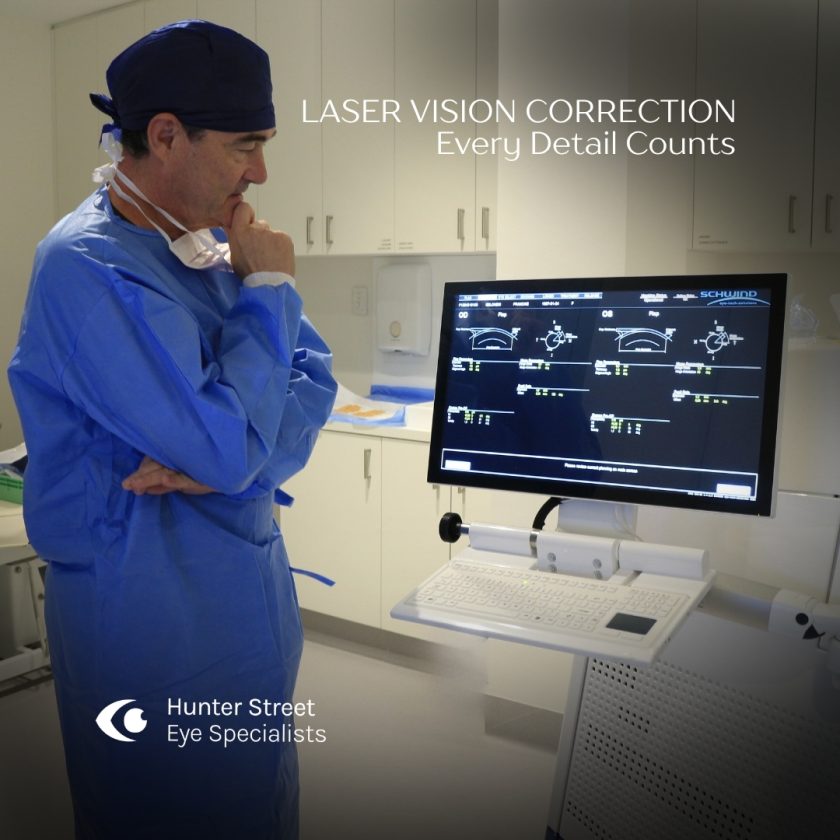
At Hunter Street Eye Specialists, we believe successful laser vision correction is about far more than choosing the latest technology or promoting a single procedure. Dr Peter Sumich combines more than two decades of refractive surgery experience with advanced diagnostic imaging, modern laser technology and careful clinical judgement to recommend the treatment that is safest and most appropriate for each individual.
Every patient undergoes a comprehensive assessment, with recommendations tailored to their eye health, prescription, lifestyle, occupation, visual goals and long-term needs. Whether that means LASIK, PRK, a lenticule procedure such as SMILE, SILK, SmartSight or CLEAR, a presbyopia solution such as PRESBYOND, or even advising that surgery is not the right option, the focus is always the same: achieving the best possible outcome for the individual patient.
Frequently Asked Questions
Am I suitable?
Only a comprehensive assessment can determine suitability. Your prescription is only one part of the decision.
How long does recovery take?
LASIK and most small-incision procedures usually recover more quickly than PRK, although healing varies between individuals.
Is laser eye surgery permanent?
The cornea is permanently reshaped, but your eyes continue to age naturally and you may still need glasses later in life.
Is it painful?
Anaesthetic eye drops are used during treatment. Most patients experience pressure rather than pain, with discomfort generally greatest after PRK.
Will I still need glasses?
Many patients become much less dependent on glasses, but no procedure can guarantee you will never need them again.
How much does it cost?
Costs vary depending on the procedure, technology, surgeon and follow-up care. It is important to understand exactly what is included in your quote.
What are the risks?
Every procedure carries risks, including dry eye, glare, halos, infection and the possibility of needing further treatment. A thorough consultation will explain the risks most relevant to your eyes.
Which procedure is best?
There is no universal answer. The best procedure is the one that offers the safest and most appropriate result for your individual eyes.
Take the Next Step
If you’re considering laser vision correction, the best place to start isn’t by choosing a procedure – it’s by having a comprehensive assessment to determine which option is most appropriate for your eyes.
At Hunter Street Eye Specialists, Dr Peter Sumich takes the time to understand your vision, lifestyle and goals before recommending a personalised treatment plan. You’ll receive honest, evidence-based advice about the options available, including whether laser vision correction is suitable for you.
To arrange a consultation with Dr Peter Sumich, contact Hunter Street Eye Specialists, We’re here to help you make an informed decision about your vision with confidence.
This article provides general information only and is not a substitute for personalised medical advice. Read our full disclaimer here