
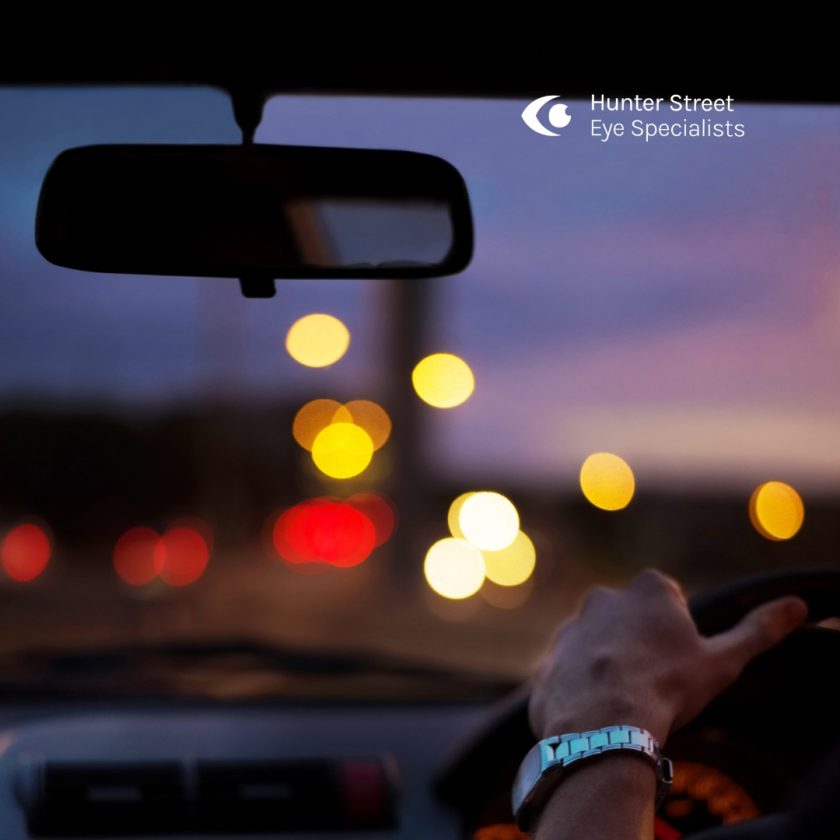
Why Do Cataracts Make Night Driving More Difficult?
Cataracts can make night driving difficult before daytime vision seems significantly blurred. A cataract clouds the eye’s natural lens, causing incoming light to scatter instead of focus cleanly. Daylight may partly mask this change. At night, reduced illumination, larger pupils and headlights against a dark background can make glare, halos and reduced contrast more noticeable.
What happens to light inside the eye?
A clear natural lens focuses light on the retina. A cataract scatters some of that light. The effect can be compared with looking through a windscreen covered by a fine haze: objects may remain visible, but headlights spread across the view and reduce clarity.
The pupil becomes larger in low light, allowing light through a wider area of the lens. Depending on the type and position of the cataract, this may make symptoms more apparent at night.
Why can the eye chart still look reasonable?
A standard vision chart uses dark letters on a bright, high-contrast background. Night driving requires the eyes to detect low-contrast objects while adapting to changing light levels and glare.
This is why someone may still read relatively small letters in the consulting room but notice halos around headlights, washed-out road markings or difficulty distinguishing objects in poorly lit areas. Visual acuity is important, but it does not measure every aspect of useful vision.
Monitoring compared with cataract surgery
Where symptoms are mild, management may include an updated glasses prescription and monitoring. Glasses can improve a focusing error, but they cannot remove the light scatter caused by clouding within the lens.
Cataract surgery removes the cloudy natural lens and replaces it with a clear artificial lens. It may improve night-time glare and contrast when the cataract is the main cause of the problem. The expected result also depends on the cornea, retina, optic nerve and the type of lens implant selected.
Possible outcomes and risks
Free from any other eye health conditions having Cataract surgery can restore vision but not if already limited by another eye condition, and in certain cases glasses may still be required. Some lens designs can also produce halos or glare, particularly in low light, which is relevant when night driving is an important visual priority.
Though complications are not common they are possible, these include infection, inflammation, bleeding, retinal swelling or detachment, changes in eye pressure and problems with the position of the lens implant. Permanent loss of vision is uncommon but with any eye procedures remains a material risk. Risks and expected benefits are based on each patient so a thorough assessment and discussion with the Surgeon is always advised.
What to consider
Difficulty driving at night can be an early functional effect of cataract, even when daytime vision or the eye chart still appears reasonable. What matters is whether the cataract is responsible and how much it affects day-to-day function. Dr Peter Sumich and Dr Ridia Lim have expertise in cataract surgery at Hunter Street Eye Specialists in Parramatta. A cataract assessment can clarify the cause of the symptoms and the available options. Learn more about cataracts here, or contact us online or call us at 02 9635 0663.
This article provides general information only and is not a substitute for personalised medical advice. Read our full disclaimer here
FAQs
Why do headlights look brighter with cataracts?
A cataract scatters light within the eye. Against a dark background, this scattered light can make headlights appear spread out and produce glare or halos.
Can cataracts affect night driving when the eye chart is still good?
Yes. A bright, high-contrast eye chart does not fully measure contrast sensitivity or the effect of glare under low-light conditions.
Does cataract surgery always improve night vision?
It may improve night vision when cataract is the main cause of the problem. The result also depends on other eye conditions and the optical characteristics of the lens implant.
About Our Specialists
Dr Peter Sumich is an ophthalmologist with a clinical focus on cataract surgery, laser vision correction and refractive lens exchange. His approach to treatment planning considers ocular measurements, overall eye health, visual requirements and each patient’s individual priorities when determining appropriate treatment options.
Dr Ridia Lim is an ophthalmologist with a clinical focus on glaucoma management, glaucoma surgery and cataract surgery. She provides comprehensive care for patients with both routine and complex glaucoma, with treatment tailored to the individual patient and their eye health.

