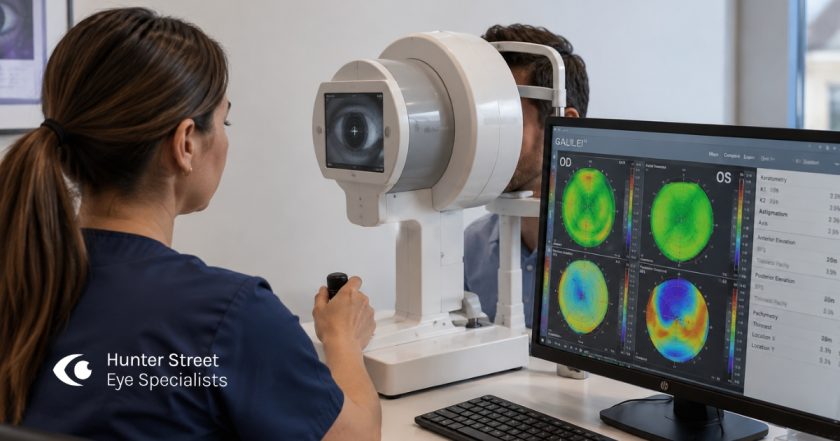
Why Is a Macular OCT Scan Needed Before Cataract Surgery?
A cataract clouds the natural lens, but the quality of vision after cataract surgery also depends on the retina behind it. A macular OCT scan uses reflected light to image the macula, the central retinal area responsible for detailed vision. It may reveal changes that are difficult to see through a cataract or on routine examination. This matters because macular health can affect the expected visual improvement and the type of lens implant considered.
What does a macular OCT show?
Optical coherence tomography, shortened to OCT, works rather like an optical ultrasound. Instead of sound waves, it uses light to measure the retinal layers. The scan is non-contact and does not use ionising radiation.
Macular OCT can show an epiretinal membrane, age-related macular degeneration, swelling or a macular hole. Some findings may not prevent cataract surgery, but can explain why vision is worse than the cataract alone suggests.
Why can a routine examination miss a macular problem?
A cataract can make the retina less clear to examine, particularly when the opacity is dense or central. An eye chart measures how small a letter can be read, but cannot identify whether reduced vision comes from the lens, macula or another part of the eye.
OCT provides a separate view of retinal structure. Current clinical guidance recommends posterior segment OCT where clinically indicated, including when vision is worse than the cataract appears to explain or when macular disease is suspected.
How can OCT affect cataract surgery planning?
A macular finding does not automatically make cataract surgery unsuitable. It can clarify how much blur comes from the cataract and how much may remain because of retinal disease, supporting a realistic discussion of expected vision.
The result may also influence lens implant selection. Multifocal and other presbyopia-correcting lenses distribute light across more than one focus and can reduce contrast. Where macular function is limited, a monofocal lens may be considered instead, depending on the retinal finding, visual priorities and full assessment.
Possible outcomes and risks
OCT does not predict an exact result or replace a dilated retinal examination. A dense cataract can weaken the scan signal. Where symptoms are mild, updated glasses and monitoring remain alternatives to surgery.
Cataract surgery may improve vision when lens clouding is the main limitation, but glasses may still be required and retinal disease may limit the result. Material risks include infection, inflammation, macular swelling, retinal tear or detachment, changes in eye pressure, lens implant problems and, rarely, permanent loss of vision.
What to consider
Macular OCT is one part of a cataract assessment. It helps show whether the cataract is the main limit on vision and whether retinal health should influence expectations or lens choice. At Hunter Street Eye Specialists in Parramatta, Sydney, cataract planning considers the lens, macula and health of the whole eye.
Learn more about cataract surgery, contact us online or by phone at 02 9635 0663 to request an appointment.
Related articles
- Why Do Cataracts Make Night Driving More Difficult?
- Why One Cataract Surgeon May Recommend a Different Lens Than Another
- Is Cataract Surgery Safe?
About the Specialists
Dr Peter Sumich is an ophthalmologist at Hunter Street Eye Specialists in Parramatta with a clinical focus on laser vision correction, refractive lens exchange and cataract surgery. He provides personalised treatment plans based on each patient’s eye health, visual needs and lifestyle.
Dr Ridia Lim is an ophthalmologist at Hunter Street Eye Specialists in Parramatta with a clinical focus on glaucoma management, glaucoma surgery and cataract surgery. She provides comprehensive care for patients with both routine and complex glaucoma, tailoring treatment to each patient’s needs.
For further information, contact Hunter Street Eye Specialists through the contact page or by phone at 02 9635 0663.
This article provides general information only and is not a substitute for personalised medical advice. Read our full disclaimer here.
FAQ’s
Does everyone need a macular OCT before cataract surgery?
Is advised but not necessary. Its use depends on the examination, symptoms, retinal risk factors, how well the cataract explains the vision and the lens implant options being considered.
Can a cataract affect the accuracy of an OCT scan?
Yes. A dense cataract can reduce the amount of light reaching and returning from the retina, which may weaken image quality or prevent a usable scan.
Does macular disease mean cataract surgery will not help?
No. Cataract surgery may still improve vision, but the amount of improvement depends on how much the cataract and the macular condition each limit vision. OCT helps inform expectations and lens choice.