What Is the Lifetime Cost of Glasses & Contact Lenses Compared with Laser Vision Correction?
About 9.4 million Australians use spectacles or contact lenses to correct refractive error, according to data reported to the Australian Institute of Health and Welfare. Research from Optometry Australia indicates that up to two-thirds of adults wear prescription glasses, with around 13% using contact lenses. For many, these options provide reliable day-to-day vision correction; however, some patients begin to question how their long-term costs compare with laser vision correction. Considering both the financial and lifestyle implications can help patients make more informed decisions about their eye care.
At Hunter Street Eye Specialists, ophthalmologists Dr Peter Sumich provide comprehensive assessments for patients considering laser vision correction. These consultations focus on eye health, suitability and realistic expectations rather than cost alone.
Understanding common vision correction options
Vision correction typically falls into three main categories: glasses, contact lenses and surgical vision correction procedures.
Glasses remain the most common solution and are suitable for almost all prescriptions. However, prescriptions often change over time, meaning many people replace their glasses regularly.
Contact lenses sit directly on the eye and may provide a wider field of view than glasses, but they require careful hygiene, ongoing purchases and regular eye care.
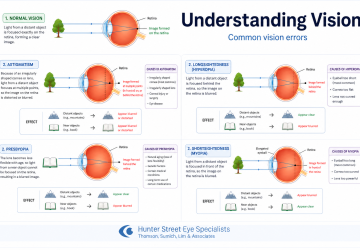
Laser vision correction procedures reshape the cornea so light focuses more accurately on the retina. Procedures commonly include LASIK, TransPRK and lenticule-based procedures like SMILE, SILK and Smartsight. These treatments aim to reduce dependence on glasses or contact lenses, although outcomes vary between individuals.
The long-term cost of glasses and contact lenses
The cost of glasses in Australia varies depending on the type of lenses and frames selected. Basic prescription glasses may start from around $99, while mid-range options commonly range between $200 and $450. Premium frames, progressive lenses, or specialised lens coatings can increase the price to more than $700.
Because prescriptions change over time and frames wear out, many adults replace their glasses every two to three years. Based on typical retail pricing and replacement patterns, modelled estimates suggest that lifetime spending on glasses alone may range from approximately $6,000 to $12,900 across adulthood.
**If a person begins wearing glasses at age 18 and continues until age 65 (47 years), estimated lifetime costs may include:
-
Lower-range scenario: about $7,050
(around $300 per pair replaced every 2 years) -
Mid-range scenario: about $9,400
(around $400 per pair replaced every 2 years) -
Higher-range scenario: about $12,925
(around $550 per pair replaced every 2 years)
Contact lenses involve ongoing costs beyond the lenses themselves. Depending on the type of lenses used, annual expenses may include replacement lenses, cleaning solutions and routine eye examinations.
In Australia, these yearly costs typically range from $600 to $1,200. Over the same 47-year period from age 18 to 65, this may equate to:
-
Lower-range scenario: about $28,200
-
Mid-range scenario: about $42,300
-
Higher-range scenario: about $56,400
For people who use both glasses and contact lenses at different times, the combined lifetime cost of visual hardware can reasonably fall between **approximately $35,000 and $65,000 or more, depending on product choices, prescription needs and wearing habits.
**These figures are illustrative estimates based on typical Australian retail pricing and replacement patterns. Calculations assume a 47-year timeframe (ages 18–65), glasses replaced approximately every 2 years at $300–$500 per pair, and annual contact lens costs of $600–$1,200. Individual costs vary depending on prescription, product selection and wearing habits.
How laser vision correction costs compare
In Australia, the cost of laser vision correction varies depending on the procedure and individual eye characteristics.
Typical price ranges reported are $3,000 to $4,000 per eye.
More complex lens-based refractive procedures may range between $5,000 and $6,500 per eye.
Medicare generally does not cover elective laser vision correction, although some private health insurance policies may provide limited rebates depending on the level of cover.
Factors beyond cost
While cost comparisons can be helpful, suitability for laser vision correction is primarily determined by clinical factors. During a consultation at Hunter Street Eye Specialists, Dr Sumich will assess prescription stability, corneal architecture including thickness, tear film health and overall eye health.
Not all patients are suitable for laser procedures. Some individuals may be better suited to lens-based refractive options, while others may continue to achieve good vision with glasses or contact lenses.
It is also important to understand that some patients may still use glasses for certain tasks after surgery, particularly as natural age-related changes in focusing occur.
Making an informed decision
Choosing between glasses, contact lenses and laser vision correction is a personal decision that should be based on medical advice, lifestyle and expectations.
A consultation can help clarify whether refractive surgery may be suitable, which procedures may be appropriate and what results are realistic for your eyes.
If you would like to discuss your vision correction options, you can contact Hunter Street Eye Specialists via form here or phone at 02 9635 0663
FAQs
Is laser vision correction cheaper than glasses over a lifetime?
Costs vary depending on prescription changes, eyewear preferences and procedure suitability. A consultation can help determine what is appropriate for your situation.
Am I suitable for laser vision correction?
Suitability depends on several factors including eye health, corneal thickness and prescription stability.
Will I still need glasses after surgery?
Some patients may still use glasses for certain tasks or as natural age-related changes occur.