Corneal Lenticule Procedures: Are They What They Cracked Up to Be?
If you’ve been researching laser vision correction, you’ve likely come across terms like SMILE, SILK, CLEAR or SmartSight. These are all forms of corneal lenticule procedures – sometimes also referred to as lenticule extraction surgery – and are often marketed as a newer alternative to LASIK.
While the terminology varies depending on the technology platform and manufacturer, the underlying surgical concept is the same.
The reality is more nuanced.
They are not a replacement for LASIK – they are another option. In some patients, they may be appropriate. In others, a different approach may be more suitable.
This article outlines what lenticule procedures involve, how they compare with LASIK, and what patients should consider when exploring their options.
At Hunter Street Eye Specialists, Dr Peter Sumich and clinical team will assess each patient individually, with recommendations based on clinical findings rather than a single preferred technique.
What are corneal lenticule procedures?
As with all laser vision correction procedures, corneal lenticule procedures reshape the cornea to improve how light focuses on the retina. What differs is where in the cornea the treatment occurs and how the laser is used.
Lenticule procedures are performed using different laser platforms and naming conventions. Common terms include SMILE (Small Incision Lenticule Extraction), SILK (Smooth Incision Lenticule Keratomileusis), CLEAR (Corneal Lenticule Extraction for Advanced Refractive Correction) and SmartSight.
Earlier terms such as FLEx (Femtosecond Lenticule Extraction) and ReLEx (Refractive Lenticule Extraction) may still appear in online resources or scientific literature. Despite the different names, they all describe variations of the same core technique.
Rather than creating a flap (as in LASIK), the procedure:
- forms a small disc of tissue within the cornea
- removes it through a small incision
- changes the corneal shape without lifting a large surface layer
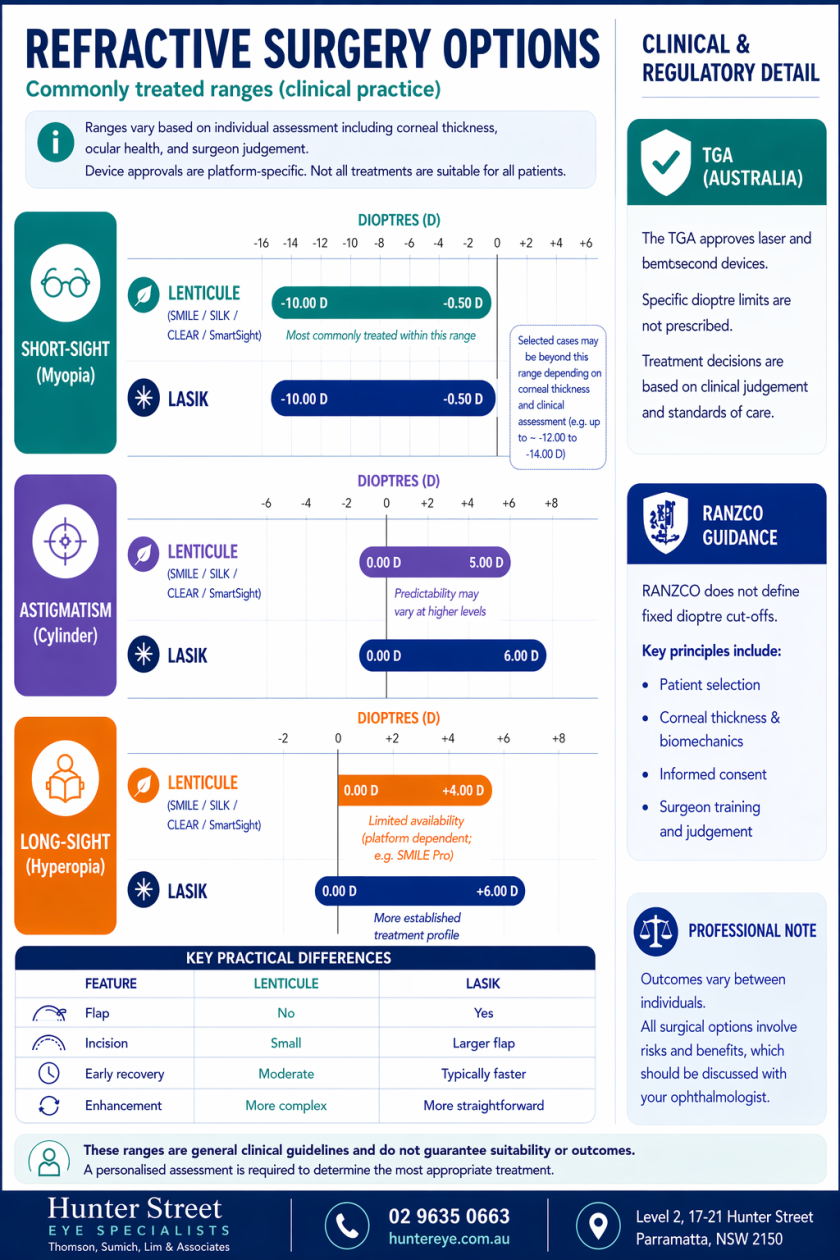
They are most commonly used for:
- short-sightedness (myopia)
- selected cases of astigmatism
- currently limited and platform-dependent availability for hyperopia (long-sightedness)
Suitability depends on individual eye measurements and overall eye health.
Why lenticule procedures (SMILE / SILK / CLEAR / SmartSight) are often discussed
There are specific features that are commonly highlighted when discussing lenticule procedures:
- No large corneal flap – the procedure is performed through a small incision
- Smaller entry point compared with LASIK
- Considerations for certain lifestyles where avoiding a flap may be relevant
These characteristics may be beneficial in selected patients. However, their relevance varies depending on individual anatomy and clinical factors.
These features relate to the surgical approach itself rather than a specific branded platform.
Limitations and disadvantages
Lenticule procedures are not suitable for all patients or all prescriptions. Points to consider include:
- Limited treatment range, particularly for long-sightedness and more complex refractive errors
- Early visual recovery may differ – some patients experience slower initial clarity compared with LASIK
- Enhancement pathways can be more complex and may involve a different technique
- Less flexibility in some treatment parameters compared with certain LASIK approaches
- As with all surgical procedures, risks exist including infection, inflammation, dry eye symptoms or visual disturbances (uncommon but important to acknowledge)
SMILE / SILK / CLEAR / SmartSight vs LASIK: head-to-head
Both lenticule procedures and LASIK aim to reduce dependence on glasses or contact lenses, but they differ in technique and recovery profile.
LASIK
- involves creating a thin corneal flap
- laser reshapes the underlying tissue
- typically associated with faster early visual recovery
- suitable across a broader range of prescriptions
SMILE / SILK / CLEAR / SmartSight / Lenticule procedures
- performed through a small incision without a large flap
- removes a lenticule of corneal tissue
- typically used for myopia and selected astigmatism
Key considerations:
- Recovery: LASIK often provides quicker early visual clarity
- Corneal structure: lenticule procedures may preserve more anterior tissue
- Treatment range: LASIK generally treats a wider range of prescriptions
- Suitability: determined by corneal measurements, prescription and eye health
Neither procedure is universally better. The most appropriate option depends on individual assessment.
Final verdict
Corneal lenticule procedures are a well-established option within modern refractive surgery.
They may be appropriate for selected patients and offer an alternative to flap-based or surface treatments. However, they are not suitable for everyone, and they do not replace other established procedures such as LASIK or TransPRK.
The most appropriate treatment is determined by:
- corneal shape and thickness
- refractive error
- ocular surface health
- individual visual needs
At Hunter Street Eye Specialists, Dr Peter Sumich and his clinical team provide personalised assessments to help patients understand which options may be appropriate for their eyes.
If you are considering vision correction, you can contact us at 02 9635 0663 or via this contact form