
Reshaping your Cornea: How does Laser Vision Correction actually work
If you’re considering laser vision correction, one of the most common questions is simple: what is the laser actually doing to my eye?
At its core, all laser vision correction procedures, whether LASIK, PRK, or newer lenticule techniques, work by reshaping the cornea so that light focuses more accurately on the retina. The principle is consistent; the method varies.
At Hunter Street Eye Specialists, procedures are performed by experienced ophthalmologist Dr Peter Sumich and his clinical team, with suitability determined on an individual clinical assessment.
How Vision Becomes Blurry
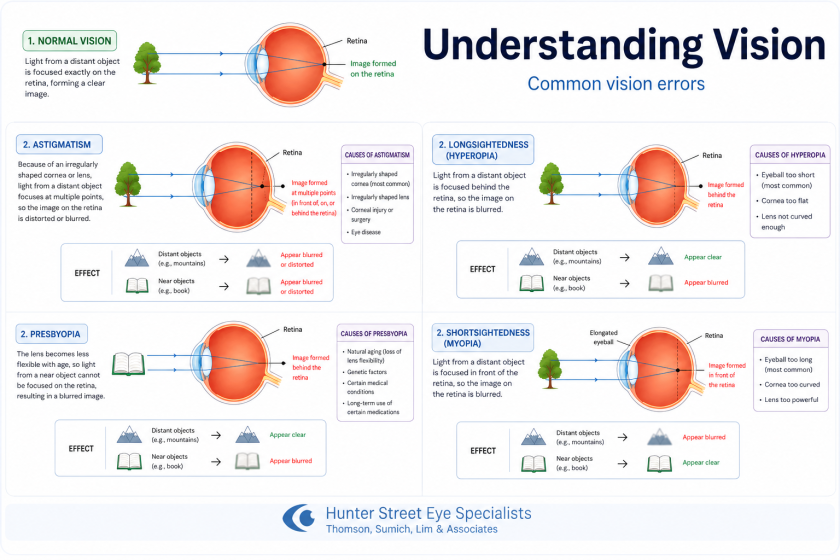
The cornea is the clear front surface of the eye and provides the majority of its focusing power by bending incoming light. When its curvature is not ideally matched to the length of the eye, light does not focus precisely on the retina:
- Myopia (short-sightedness): light focuses in front of the retina
- Hyperopia (long-sightedness): light focuses behind the retina
- Astigmatism: light focuses at multiple points due to an irregular corneal shape
- Presbyopia: an age-related condition in which the crystalline lens loses flexibility, reducing the ability to focus on near objects
Laser vision correction works by subtly reshaping the cornea to reduce these refractive errors and bring light into clearer focus on the retina.
What the Laser Actually Does
The laser removes microscopic amounts of corneal tissue in a highly controlled pattern, reshaping the cornea and altering how light is focused as it enters the eye.
- Myopic Laser Treatment: the cornea is flattened
- Hyperopic Laser Treatment: the central cornea is steepened
- Astigmatic Laser Treatment: the cornea is made more uniformly curved (regularised)
By reshaping the cornea, laser vision correction reduces refractive error and improves focus, often reducing or eliminating the need for glasses or contact lenses.
Different Techniques, Same Goal
- LASIK (also referred to as femto-LASIK, bladeless LASIK, wavefront-guided LASIK): a thin corneal flap is created, the laser reshapes the central corneal (stromal) tissue, and the flap is repositioned
- PRK / TransPRK (also known as surface ablation, Advanced Surface Ablation [ASA], LASEK, epi-LASIK): the corneal surface epithelium is removed, and the laser reshapes the anterior cornea (no flap)
- Lenticule procedures (e.g. SMILE/SILK/Smartsight/CLEAR): a small incision is made, and a disc-shaped lenticule is created within the cornea and removed to change its shape
Many of these names describe small differences in how the procedure is done or are simply marketing terms, rather than completely different ways of correcting vision.
Considerations
Laser vision correction can significantly improve vision by reshaping the cornea, but it is not suitable for everyone and results can vary. Some patients may require enhancement procedures, and like any surgery, there are risks including dry eye, glare or halos, under- or overcorrection, and rarely, infection. A personalised assessment is essential to determine suitability and expected outcomes.
Disclaimer: General information only – please seek personalised advice.

