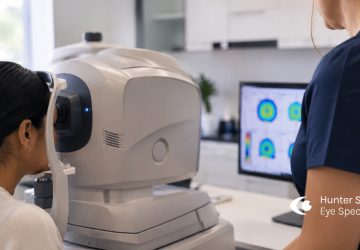
Why Are Your Eyes Dilated at a Pre-Operative Eye Review?
Dilating drops may be used during a pre-operative eye review to enlarge the pupil and allow a clearer examination of structures behind it. Depending on the procedure and clinical findings, the drops may also temporarily relax the eye’s internal focusing system so the prescription can be checked. Dilation can provide useful information before cataract surgery, clear lens exchange or refractive lens exchange, and laser vision correction, although the purpose is not necessarily the same in every assessment.
What does dilation allow us to examine?
The pupil is the opening through which the ophthalmologist examines the inside of the eye. In normal lighting it remains relatively small, limiting the view in much the same way as looking into a room through a narrow doorway.
Dilating drops enlarge this opening. This provides a wider view of the natural lens, retina, macula and optic nerve. These structures all contribute to vision and may affect the expected result of surgery.
The drops can temporarily cause light sensitivity and blurred near vision. The duration varies according to the type of drop used and the individual eye.
Why is dilation relevant before cataract surgery or lens exchange?
Cataract surgery, clear lens exchange and refractive lens exchange all involve removing the natural lens and replacing it with an artificial intraocular lens.
Before considering lens surgery, it is important to establish whether the cataract or focusing error adequately explains the patient’s vision. Macular disease, optic nerve damage or another retinal condition may limit the visual result even when the lens procedure itself is uncomplicated.
The examination can therefore influence:
- whether lens surgery is appropriate
- the expected improvement in vision
- the type of intraocular lens considered
- whether further retinal imaging or assessment is required.
Why might dilation be used before laser vision correction?
Laser vision correction reshapes the cornea rather than replacing the natural lens. Dilation may still be useful when the ophthalmologist needs a more complete view of the retina or other internal structures.
Some dilating drops also relax accommodation, the eye’s internal focusing mechanism. This allows a cycloplegic refraction to be performed when there is a clinical reason to confirm the underlying prescription. It can be particularly useful when measurements vary, symptoms do not fit the standard prescription or long-sightedness may be partly concealed by active focusing.
Dilation may not be necessary when the prescription is stable and repeatable, the internal eye examination is satisfactory and there are no symptoms or findings requiring a wider retinal view. Laser vision correction planning is primarily based on the prescription, corneal shape and thickness, tear-film quality and overall eye health. Whether dilation adds useful information depends on the individual assessment.
Limitations and possible effects
A dilated examination provides additional information, but it does not predict an exact surgical outcome or replace other investigations. Corneal imaging, retinal scans, lens measurements, tear-film assessment and prescription stability may also be relevant, depending on the procedure.
Temporary effects can include light sensitivity, difficulty focusing at near and blurred vision. Less commonly, drops can cause irritation, an allergic response or a rise in eye pressure.
What to consider
Dilation allows the ophthalmologist to assess parts of the eye that cannot always be examined fully through an undilated pupil. The findings are interpreted differently depending on whether cataract surgery, lens exchange or laser vision correction is being considered.
At Hunter Street Eye Specialists in Parramatta, pre-operative planning considers the proposed procedure, the patient’s visual requirements and the health of the whole eye.
Add the following sections after What to consider.
Related articles
- Why Is a Macular OCT Scan Sometimes Needed Before Cataract Surgery?
- Why Does Your Prescription Need to Be Stable Before Laser Eye Surgery?
- Why Does the Tear Film Matter Before Laser Eye Surgery?
About the Specialists
Dr Peter Sumich is an ophthalmologist at Hunter Street Eye Specialists in Parramatta with a clinical focus on laser vision correction, refractive lens exchange and cataract surgery. He provides personalised treatment plans based on each patient’s eye health, visual needs and lifestyle.
Dr Ridia Lim is an ophthalmologist at Hunter Street Eye Specialists in Parramatta with a clinical focus on glaucoma management, glaucoma surgery and cataract surgery. She provides comprehensive care for patients with routine and complex glaucoma, tailoring treatment to each patient’s needs.
For further information, contact Hunter Street Eye Specialists through our contact page.
This article provides general information only and is not a substitute for personalised medical advice. Read our full disclaimer here.
Frequently asked questions
Does everyone need dilating drops before eye surgery?
Not necessarily. Whether dilation is required depends on the procedure being considered, the structures that need to be examined and the findings from the initial assessment.
Why is my near vision blurred after dilating drops?
Some dilating drops temporarily reduce accommodation, the eye’s ability to adjust focus for near tasks. The enlarged pupil can also increase sensitivity to light. These effects usually continue while the drops remain active.
Are the same dilating drops used for every pre-operative assessment?
Not always. Different drops have different effects and durations. The drops selected depend on whether the purpose is to enlarge the pupil, relax accommodation or achieve both effects.