
Why Does the Tear Film Matter Before Laser Eye Surgery?
The tear film is the thin layer of fluid covering the cornea, and it forms the eye’s first optical surface. If that layer breaks up too quickly or becomes uneven, vision can fluctuate and corneal measurements may become less repeatable. This matters before laser eye surgery because treatment planning relies on an accurate map of the cornea. Dry eye does not automatically rule out laser vision correction, but its cause and severity need to be understood during assessment.
What is the tear film?
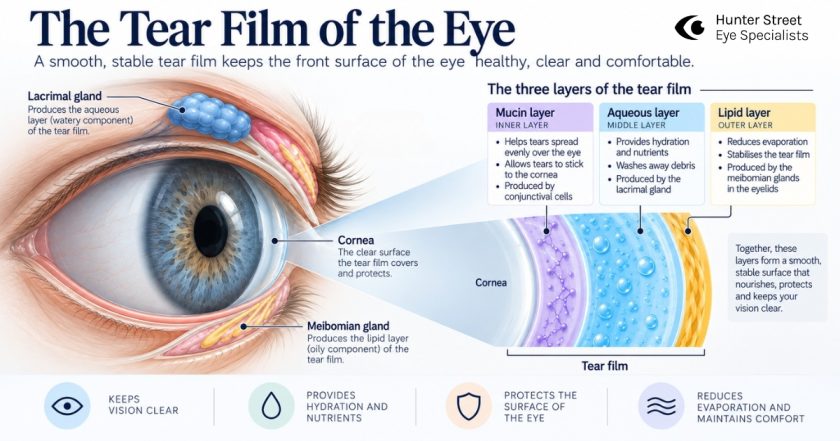
The tear film is more than water. It has an outer oily layer that slows evaporation and an underlying fluid layer containing mucins, which help the tears spread evenly and adhere to the corneal surface. With each blink, these components combine to create a smooth, comfortable and optically clear surface.
A useful comparison is a freshly cleaned windscreen. When the fluid forms an even layer, the view remains clear. When it breaks up into patches, fine detail can blur or fluctuate. Patients may notice vision that briefly clears after blinking, along with burning, grittiness, watering or tired eyes.
Why can dry eye affect laser planning?
Laser vision correction changes corneal shape by a calculated amount. Assessment commonly includes the glasses prescription, corneal curvature and detailed topography or tomography. These measurements are taken through the tear film, so an unstable surface can make the cornea appear slightly different from one test to the next.
The examination may consider tear-film breakup, corneal staining, eyelid and meibomian gland health, tear volume and whether measurements remain consistent. These findings help distinguish evaporative dry eye, reduced tear production and other ocular-surface conditions because their surgical relevance can differ.
Do laser procedures affect the tear film differently?
Corneal nerves help regulate blinking, tear production and surface repair. LASIK, surface laser procedures such as PRK, and lenticule procedures all affect corneal tissue and nerves in different patterns. Dry-eye symptoms can therefore occur after any corneal laser procedure, particularly during healing.
Some studies report fewer early dry-eye signs after small-incision lenticule procedures than after LASIK, but this does not determine suitability by itself. PRK avoids a corneal flap but still disrupts the surface during healing. Procedure choice also depends on prescription, corneal measurements, recovery requirements and broader eye health.
Possible outcomes and risks
Laser eye surgery may temporarily worsen dryness or produce new dry-eye symptoms. These can include discomfort, light sensitivity and vision that varies between blinks. Symptoms often improve as the surface and corneal sensation recover, but persistent or severe dry eye can occur.
Other possible outcomes include under-correction, over-correction, residual astigmatism, glare, halos and a continuing need for glasses. Less common complications include infection, inflammation and corneal weakening. An ocular surface that cannot be made sufficiently stable may make surgery unsuitable. Glasses and contact lenses remain non-surgical alternatives.
What to consider
A clear eye chart does not prove that the tear film is stable. The practical question is whether the ocular surface can provide comfortable, repeatable vision and dependable measurements. At Hunter Street Eye Specialists in Parramatta, Sydney, tear-film findings are considered alongside the prescription, corneal maps and overall eye health when assessing laser vision correction suitability.
Learn more about laser vision correction, or contact Hunter Street Eye Specialists online via this link or speak to one of our friendly team members at 02 9635 0663.
Related articles
- Why Do Contact Lenses Need to Come Out Before a Laser Eye Surgery Assessment?
- Why Does Your Prescription Need to Be Stable Before Laser Eye Surgery?
- Can Laser Eye Surgery Correct Astigmatism?
About the Specialist
Dr Peter Sumich is an ophthalmologist at Hunter Street Eye Specialists in Parramatta with a clinical focus on laser vision correction, refractive lens exchange and cataract surgery. He provides personalised treatment plans based on each patient’s eye health, visual needs and lifestyle.
For further information, contact Hunter Street Eye Specialists through the contact page or by phone at 02 9635 0663.
This article provides general information only and is not a substitute for personalised medical advice – Read Our Disclaimer Here
FAQs
Can someone with dry eye have laser eye surgery?
Possibly. Dry eye is not automatically an exclusion, but suitability depends on its cause, severity, ocular-surface findings and whether stable measurements can be obtained.
Why does my vision clear after blinking?
Blinking temporarily spreads a fresh tear layer across the cornea. If the tear film is unstable, this may briefly smooth the optical surface before the fluid begins to break up again.
Is one laser procedure better for dry eye?
Procedures affect corneal tissue and nerves differently, and some may produce fewer early dry-eye signs in selected groups. The appropriate procedure depends on the full refractive and ocular-surface assessment rather than dry eye alone.


