Why You Need to Stop Wearing Contact Lenses Before a Laser Eye Surgery Assessment
Contact lenses sit directly on the cornea, the clear front surface of the eye. While they correct focus, they can also temporarily alter corneal shape and the tear film. Laser eye surgery planning depends on accurate, repeatable measurements of both. This is why contact lenses usually need to be left out before a refractive assessment, with the required time depending on the lens type and how quickly the cornea returns to its natural shape.
What do contact lenses change?
A contact lens applies a small physical influence to the corneal surface. Soft lenses generally mould to the eye, while rigid/hard and orthokeratology lenses can produce a more pronounced change in corneal curvature. Lens wear may also affect the tear film and eye surface.
These effects are often temporary, but corneal mapping can detect changes much smaller than a patient would notice. Removing the lenses allows the cornea and tear film to settle before testing.
Why does this matter for laser planning?
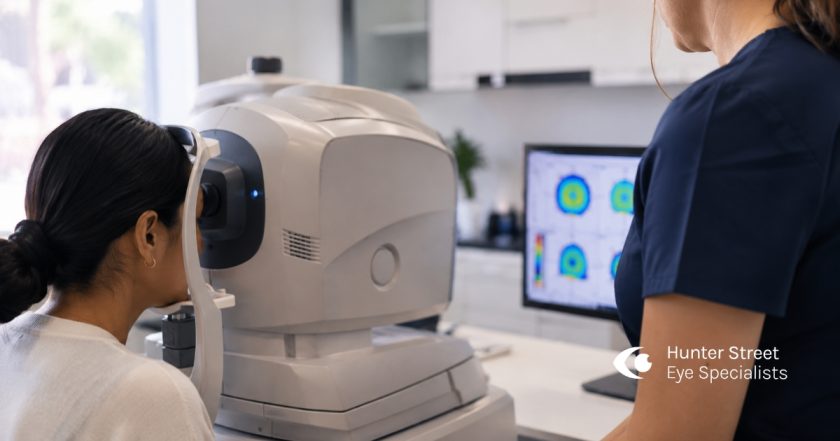
Laser vision correction reshapes the cornea according to measurements taken before treatment. Assessment usually includes the focusing prescription, corneal curvature, thickness and detailed topography or tomography.
If a contact lens has temporarily distorted the cornea, the maps may not represent its natural shape. This can affect the apparent prescription, assessment of suitability and treatment calculation. We advise patients to stop wearing soft contact lenses approximately 4 to 7 days before baseline LASIK evaluation because the cornea may take time to return to its natural shape. Hard contact lenses may need to be out for 2 weeks up to 1 month.
How long should contact lenses be left out?
There is no single interval for every patient. The time required depends on:
- the type of contact lens
- how frequently and how long it has been worn
- the tear film and eye surface
- whether repeat measurements are stable.
Rigid and orthokeratology lenses often require a longer lens-free period than standard soft lenses. If the first maps show distortion or differ between visits, further time without lenses and repeat testing may be needed. Glasses remain the practical alternative during this period.
Possible outcomes and risks
Leaving lenses out does not make someone suitable for surgery; it improves the reliability of the assessment. Even with stable measurements, laser vision correction may result in residual prescription, dry-eye symptoms, glare, halos, fluctuating vision or a need for glasses or further treatment. Less common risks include infection, inflammation and corneal weakening. Continuing with glasses or contact lenses remains a non-surgical alternative. Learn more about via this link laser vision correction.
What to consider
The lens-free period is part of obtaining dependable measurements. Follow the specific instructions provided for the lens type rather than assuming a standard interval.
At Hunter Street Eye Specialists in Parramatta, a refractive assessment considers corneal measurements, prescription stability, tear-film quality and overall eye health.
Learn more about laser vision correction, contact the practice via phone at 02 9635 0663, through the contact page or book an appointment to find out if you are suitable here.
Related articles
- Why Does Your Prescription Need to Be Stable Before Laser Eye Surgery?
- Can Laser Eye Surgery Correct Astigmatism?
- Understanding LASIK, SMILE, SILK, SmartSight, CLEAR, PRESBYOND and PRK
About the Specialist
Dr Peter Sumich is an ophthalmologist at Hunter Street Eye Specialists in Parramatta with a clinical focus on laser vision correction, refractive lens exchange and cataract surgery. He provides personalised treatment plans based on each patient’s eye health, visual needs and lifestyle.
For further information, contact Hunter Street Eye Specialists via phone at 02 9635 0663, through the contact page or book an appointment to find out if you are suitable here.
This article provides general information only and is not a substitute for personalised medical advice. Read our full disclaimer here.
FAQs
How long should I stop wearing contact lenses before a laser eye surgery assessment?
The required time depends on the type of contact lens and how quickly the cornea returns to a stable shape. Rigid and orthokeratology lenses generally require longer than standard soft lenses. Speak to one of our friendly laser consultants via phone at 02 9635 0663 of via booking form to discuss what’s best for you.
Why do contact lenses affect corneal mapping?
Contact lenses can temporarily alter corneal curvature and the tear film. If measurements are taken before these changes settle, the maps may not represent the cornea’s natural shape.
What happens if my corneal measurements are not stable?
Further time without contact lenses and repeat measurements may be required. Stable, repeatable measurements are important before suitability or treatment planning can be determined.