
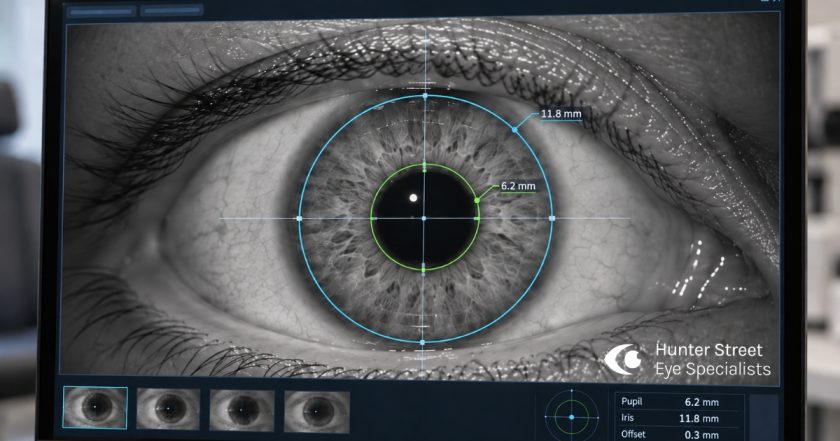
Why Is Pupil Size Measured Before Laser Eye Surgery?
Pupil size is measured before laser eye surgery because the pupil controls how much of the cornea is used for vision under different lighting conditions. It becomes smaller in bright light and larger in the dark. When the pupil enlarges, light enters through a wider area of the cornea, which may make optical imperfections more noticeable. Pupil size is therefore considered when assessing night vision and planning treatment, but it does not determine suitability on its own.
What does the pupil do?
The pupil is the opening in the centre of the iris. It works like the aperture in a camera, becoming smaller in bright light and larger when less light is available. This response helps regulate the amount of light reaching the retina.
A larger pupil also exposes more of the cornea’s optical surface. Small differences in corneal shape that have little effect during the day may become more noticeable in dim light, when the pupil opens wider.
Why does pupil size matter for treatment planning?
Laser vision correction reshapes a central optical zone of the cornea, with a surrounding transition zone that blends the treatment into untreated tissue. Planning must balance the prescription, the intended treatment diameter and the amount of corneal tissue required.
Modern treatment profiles and eye-tracking systems have reduced the importance of pupil size as a single risk measure. There is no universal pupil-size cut-off that applies to every patient. The measurement is interpreted alongside the prescription, corneal shape and thickness, tear film and existing night-vision symptoms.
What causes glare and halos at night?
At night, bright headlights are viewed against a dark background while the pupil is relatively large. Optical blur around a point of light may then be seen as glare, halos or starbursts. Reduced contrast can also make road markings and objects harder to distinguish.
These symptoms are not caused by pupil size alone. An unstable tear film, residual prescription, corneal irregularity and the normal healing response can also affect visual quality after treatment. Symptoms may improve as the eye heals, but persistent night-vision disturbance can occur.
Possible outcomes and risks
Measuring the pupil helps inform planning, but it cannot predict exactly who will experience night-vision symptoms. A large low-light pupil does not automatically exclude laser treatment, and a smaller pupil does not remove the possibility of glare or halos.
Other possible outcomes include dry-eye symptoms, fluctuating vision, under-correction, over-correction, residual astigmatism and continued use of glasses. Less common complications include infection, inflammation and corneal weakening. Glasses and contact lenses remain non-surgical alternatives, while lens-based correction may be considered in selected circumstances.
What to consider
Pupil size is one part of a refractive assessment rather than a pass-or-fail measurement. Its significance depends on the prescription, corneal measurements, treatment profile and the patient’s visual requirements, particularly night driving. At Hunter Street Eye Specialists in Parramatta, Sydney, these findings are considered together when assessing laser vision correction suitability.
Learn more about laser vision correction, or contact Hunter Street Eye Specialists online via this link or speak to one of our friendly team members at 02 9635 0663.
Find out if you are suitable for laser vision correction by taking our online suitability test here.
Related articles
- Why Does the Tear Film Matter Before Laser Eye Surgery?
- Why Does Your Prescription Need to Be Stable Before Laser Eye Surgery?
- Can Laser Eye Surgery Correct Astigmatism?
About the Specialist
Dr Peter Sumich is an ophthalmologist at Hunter Street Eye Specialists in Parramatta with a clinical focus on laser vision correction, refractive lens exchange and cataract surgery. He provides personalised treatment plans based on each patient’s eye health, visual needs and lifestyle.
For further information, contact Hunter Street Eye Specialists via phone at 02 9635 0663, through the contact page or book an appointment to find out if you are suitable here.
This article provides general information only and is not a substitute for personalised medical advice. Read Our Disclaimer Here
FAQs
Does a large pupil make laser eye surgery unsuitable?
Not automatically. Pupil size is interpreted with the prescription, corneal measurements, treatment profile, tear film and existing visual symptoms. Suitability depends on the complete assessment.
Why is pupil size measured in dim light?
The pupil enlarges when illumination falls. Measuring it under controlled low-light conditions helps estimate how much of the cornea contributes to vision at night.
Can glare and halos occur with a small pupil?
Yes. Pupil size is only one factor. Tear-film instability, residual prescription, corneal irregularity and healing can also contribute to glare, halos or fluctuating vision.
