
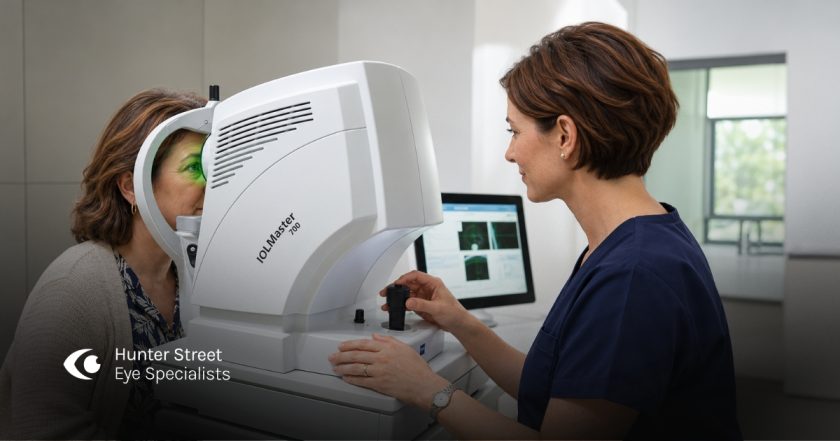
Why Might Cataract Surgery Measurements Need to Be Repeated?
Cataract surgery measurements may be repeated when results are inconsistent, unusual or affected by the eye surface. Biometry measures the eye’s length and optical features, while keratometry measures corneal curvature. These figures guide the intraocular lens calculation. Repeating them is a quality check that helps confirm the plan.
What is being measured?
The artificial lens has a fixed optical power. Selecting it requires the eye’s length, corneal curve and other anatomical measurements. It is similar to measuring for a prescription lens that will sit inside the eye: small differences can change the predicted focus.
The Australian Cataract Clinical Care Standard supports discussion of expected outcomes and limitations. International guidance recommends optical biometry for eye length and keratometry for corneal curvature, with additional imaging when the cornea is irregular.
Why might the results differ?
An unstable tear film can alter the reflected image used to measure the cornea. Contact lens wear, poor fixation, a dense cataract or an unusual eye shape can also reduce repeatability. Previous laser vision correction changes corneal relationships, making standard calculations less reliable.
The device may flag a result, or measurements may not agree with the other eye, glasses prescription or corneal map. Repeating the test or using another method can show whether the difference is real or technical.
What can repeat measurements change?
A confirmed result may leave the plan unchanged. A meaningful difference can alter lens power, astigmatism correction or intended focus. The surgeon considers the complete pattern rather than one isolated number, particularly when planning a toric lens.
Possible outcomes and risks
Repeated biometry improves planning confidence but cannot predict final focus exactly. Glasses may still be required, and another eye condition may limit vision. Material risks include infection, inflammation, macular swelling, retinal tear or detachment, pressure changes, lens implant problems and, rarely, permanent loss of vision. Monitoring with updated glasses remains an alternative.
What to consider
A repeat test is useful when it resolves uncertainty that could affect lens choice or expected focus. At Hunter Street Eye Specialists in Parramatta, Sydney, measurements are interpreted with the eye examination, corneal imaging, visual priorities and health of the whole eye.
Learn more about cataract surgery, or contact Hunter Street Eye Specialists online here or by calling us at 02 9635 0663 to discuss or request an appointment.
Related articles
- Why Is a Macular OCT Scan Sometimes Needed Before Cataract Surgery?
- Why One Cataract Surgeon May Recommend a Different Lens Than Another
- Will I Still Need Glasses After Cataract Surgery?
About the Specialists
Dr Peter Sumich is an ophthalmologist at Hunter Street Eye Specialists in Parramatta with a clinical focus on laser vision correction, refractive lens exchange and cataract surgery. He provides personalised treatment plans based on each patient’s eye health, visual needs and lifestyle.
Dr Ridia Lim is an ophthalmologist at Hunter Street Eye Specialists in Parramatta with a clinical focus on glaucoma management, glaucoma surgery and cataract surgery. She provides comprehensive care for patients with both routine and complex glaucoma, tailoring treatment to each patient’s needs.
For further information, contact Hunter Street Eye Specialists through the contact page or by phone at 02 9635 0663.
This article provides general information only and is not a substitute for personalised medical advice. Read our full disclaimer here


