Why Is Eye Dominance Tested Before Laser Eye Surgery?
Eye dominance is the tendency to rely slightly more on one eye for precise visual direction. It does not mean that eye is healthier or has a stronger prescription. Testing dominance before laser eye surgery can help plan how the two eyes should work together, particularly when blended vision or monovision is being considered to reduce dependence on reading glasses.
What is eye dominance?
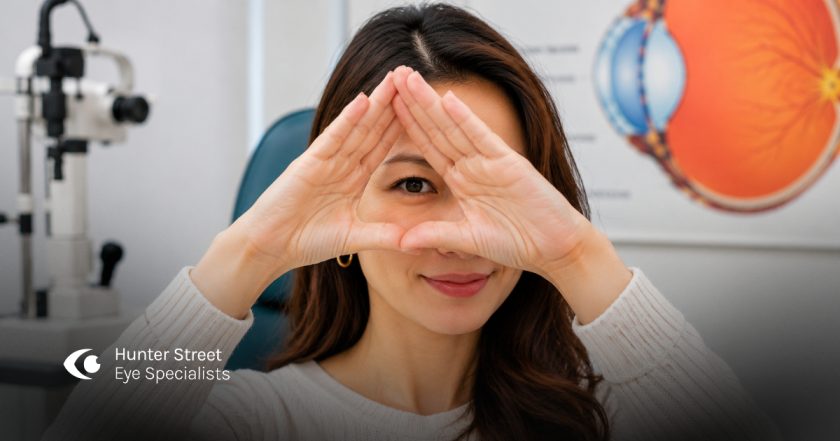
Both eyes contribute to a single view, but the brain may give one eye priority for tasks such as looking through a small opening. This is ocular dominance. Like being right- or left-handed, the preference may be mild and vary with the test used.
Dominance is assessed alongside the prescription, visual acuity and binocular vision, meaning how effectively the eyes work together. It does not determine treatment on its own.
Why does it matter when planning distance and near vision?
For standard laser vision correction, both eyes are usually planned for clear distance focus. Eye dominance may have limited influence on that treatment target.
It becomes more relevant when presbyopia has reduced the natural lens’s ability to focus at near. In blended vision or monovision, the dominant eye is commonly planned for distance and the other eye for closer tasks. The brain then uses the clearer image for the task at hand. Laser treatment does not restore the lens’s lost focusing ability; it creates a controlled difference between the eyes to extend the useful range of vision.
Monovision may reduce reliance on reading glasses by making one eye mildly short-sighted. Before treatment, a contact lens trial can simulate the proposed balance, usually with the dominant eye corrected for distance and the other eye left mildly short-sighted for near. Wearing this arrangement during normal activities provides a practical test drive of reading, screen use, depth perception and night vision – essentially allowing patients to test drive mono/blended vision. It can identify poor tolerance, although it cannot reproduce every aspect of a surgical result.
Possible outcomes and risks
Blended vision can improve functional distance and near vision for selected patients, but it does not reproduce the focusing range of a younger natural lens. Fine print, prolonged reading or dim-light tasks may still require glasses.
The deliberate difference between the eyes can reduce depth perception or contrast for some tasks, and not everyone adapts comfortably. Laser vision correction also carries risks including residual prescription, dry-eye symptoms, glare, halos and fluctuating vision. Less common complications include infection, inflammation and corneal weakening. Glasses, contact lenses and, in selected circumstances, lens-based correction remain alternatives.
What to consider
Eye dominance provides useful information, but the treatment decision also depends on age, prescription, corneal measurements, eye health, occupation and the visual tasks that matter most. A strong preference for one eye or poor tolerance during a trial may change the proposed balance between distance and near.
At Hunter Street Eye Specialists in Parramatta, Sydney, refractive planning considers how each eye focuses and how the two eyes function together. Learn more about laser vision correction, or use the contact page to enquire or request an appointment.
Related articles
- Why Does Your Prescription Need to Be Stable Before Laser Eye Surgery?
- Why Does the Tear Film Matter Before Laser Eye Surgery?
- Can You Get Rid of Reading Glasses After 40?
About the Specialist
Dr Peter Sumich is an ophthalmologist at Hunter Street Eye Specialists in Parramatta with a clinical focus on laser vision correction, refractive lens exchange and cataract surgery. He provides personalised treatment plans based on each patient’s eye health, visual needs and lifestyle.
For further information, contact Hunter Street Eye Specialists via phone at 02 9635 0663, through the contact page or book an appointment to find out if you are suitable here.
This article provides general information only and is not a substitute for personalised medical advice. Read Our Disclaimer Here
FAQs
Does the dominant eye always have better vision?
No. Eye dominance describes which eye the brain tends to prioritise for directional visual tasks. It does not necessarily mean that eye has better acuity, a lower prescription or better eye health.
Is eye dominance important for every laser eye surgery procedure?
It is most relevant when the two eyes may be given different focusing targets, such as blended vision or monovision. It may have less effect when both eyes are planned for the same distance target.
Can blended vision be tested before laser treatment?
A contact lens trial may simulate the proposed distance and near balance before treatment. Wearing the lenses during normal activities can help assess reading, screen use, depth perception, night vision and overall tolerance. The trial is useful, but it cannot reproduce every aspect of a surgical result.